
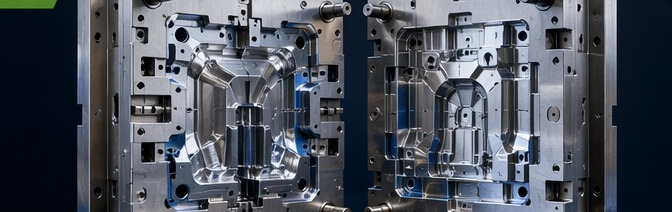
When you source CNC parts, injection molds or molded production from China, the first commercial risk is often not steel grade or cycle time—it is who actually owns the machines, tools and quality system. An OEM manufacturer machines and molds in-house; a trading company resells capacity. Both can quote, but only one controls process capability, schedule and IP handling end-to-end.
When you source CNC parts, injection molds or molded production from China, the first commercial risk is often not steel grade or cycle time—it is who actually owns the machines, tools and quality system. An OEM manufacturer machines and molds in-house; a trading company resells capacity. Both can quote, but only one controls process capability, schedule and IP handling end-to-end.
This guide explains practical differences, red flags in RFQs, and how overseas buyers can verify a Dongguan factory such as HC-Mold before awarding tooling or production.
Why the distinction matters for export OEM programs
Tooling ownership, T1 sample schedules, mold steel certificates and CAPA after dimensional rejects all depend on the factory floor. Traders can be useful for multi-vendor consolidation, but hand-offs multiply when you need 5-axis CNC prototypes, multi-cavity molds and production molding under one program manager.
- Schedule control: CNC, EDM, mold tryout and molding share one capacity plan at a manufacturer.
- IP boundary: fewer subcontractors means fewer copies of your CAD outside the NDA chain.
- Root-cause speed: dimensional issues are fixed at the same site that cut the mold and ran the shot.
- Cost transparency: factory quotes separate tool amortization from piece price more clearly than layered markups.
Signals that indicate a real manufacturer
Do not rely on stock photos. Ask for evidence that maps to your process mix—CNC, tooling, injection molding or die casting.
| Check | Manufacturer signal | Trader risk signal |
|---|---|---|
| Factory audit | Named address, machine list, live production | Showroom only / “partner factory” |
| RFQ response | DFM notes, steel/cavity options, open questions | One-line price, no process questions |
| Certificates | ISO 9001:2015 on legal entity name | Vague “certified suppliers” |
| Sample path | T1 from same site as production mold | Sample from different city than tool |
| Ownership | Written tooling ownership clause | Tool “stays with network” |
Questions to put in every China OEM RFQ
- Legal entity name on commercial invoice and ISO certificate.
- Which processes are in-house vs subcontracted (heat treat, plating, 3D print).
- Machine park relevant to your job (3/4/5-axis CNC, injection tonnage range, die-cast machines).
- Who stores the mold, who pays storage, and who may run the tool.
- Inspection equipment (CMM, optical, hardness) and sample report format.
How HC-Mold positions as a direct OEM
HC-Mold International Co., Limited manufactures prototypes, CNC parts, injection molds, plastic molding and die casting in Chang'an, Dongguan, Guangdong under ISO 9001:2015. Engineering can review drawings before quote; free DFM is available on complete packages. Commercial SLA: reply ≤12 hours, quote ≤24 hours when drawings, material, volume and finish are clear.
When a trading layer can still make sense
If you need dozens of unrelated commodities consolidated into one shipment, a trader may help. For custom molds, precision CNC and branded housings, prefer a single factory with documented process ownership.
Practical audit questions during a Dongguan visit
Walk the process path your part will take: receiving inspection, CNC or EDM, mold fitting, tryout press, final QC and packing. Ask operators which job is live on the machine and request a recent first-article report with the same inspection method you will use. Photograph nameplates only with permission and match them to the capacity list in the quotation.
Confirm who programs CAM, who designs molds, and who owns schedule recovery when a T1 fails. Manufacturers with integrated project managers can re-sequence EDM and tryout without waiting on an external trading desk. That operational detail is often the difference between a promise and a ship date.
For multi-process OEM work—prototype CNC today, multi-cavity mold next quarter—ask whether the same engineers retain design history. Continuity reduces re-learning of datums, cosmetic standards and packaging rules when volume ramps.
FAQ
Can a trading company still deliver good molds?
Yes, if the factory behind them is capable—but you lose direct schedule control and often pay a markup without engineering ownership. Ask to contract and audit the actual mold shop.
What documents prove manufacturing status?
Business license matching the quote entity, ISO 9001:2015 certificate, factory address with machine photos dated to your visit or video call, and process capability notes on your RFQ.
Is Alibaba Trade Assurance proof of being a factory?
Trade Assurance is a transaction protection program, not a process audit. Still verify the workshop and which steps are subcontracted.
How should I start with HC-Mold?
Send STEP CAD, critical 2D, material, volume band and cosmetic requirements to contact@hc-mold.cn or the RFQ form. Prototype CNC often starts at MOQ 1 piece.
Ready to source from a verified OEM manufacturer? Send your STEP/IGES drawings, material notes, volume band and finish requirements via our RFQ form. HC-Mold International Co., Limited is a direct OEM manufacturer in Chang'an, Dongguan, Guangdong, China (ISO 9001:2015). Contact: contact@hc-mold.cn · +86-769-85327002. Free DFM review; reply ≤12h and quote ≤24h on complete RFQ packages.
Talk to HC-Mold engineering
Free DFM · reply ≤12h · quote ≤24h on complete RFQ · ISO 9001:2015 · Dongguan, China