
Vacuum Casting Services in China
HC-Mold makes cast urethane parts in silicone molds in Chang'an, Dongguan: 1 to 500 polyurethane parts in rigid, flexible or clear grades, delivered in 5–7 days. Use vacuum casting for parts that must look and feel like injection molded parts before you invest in a production mold.
Vacuum casting capabilities
- Quantity
- 1–500 parts; no minimum order
- Lead time
- 5–7 days for the first parts, depending on size and quantity
- Process
- Master pattern, silicone mold, polyurethane cast under vacuum
- Master pattern
- CNC machined or SLA 3D printed from your CAD
- Materials
- Polyurethane casting resins in rigid (ABS-like, PP-like, PC-like), flexible (rubber-like) and clear grades
- Color
- Pigmented in the resin or painted after casting
- Finishing
- Sanding, bead blasting, painting, plating, screen printing
- Inspection
- Full inspection report with every shipment
What to send for a vacuum casting quote
- 3D files (STEP, IGES, SolidWorks or STL) and a 2D PDF for critical dimensions
- Quantity and the date you need parts
- Required properties: rigid, flexible or clear, hardness, color and finish
- What the parts are for: appearance models, fit tests, user trials or pilot sales
We sign an NDA before any file review. Complete packages get a reply within 12 hours and a quote within 24 hours.
How vacuum casting works
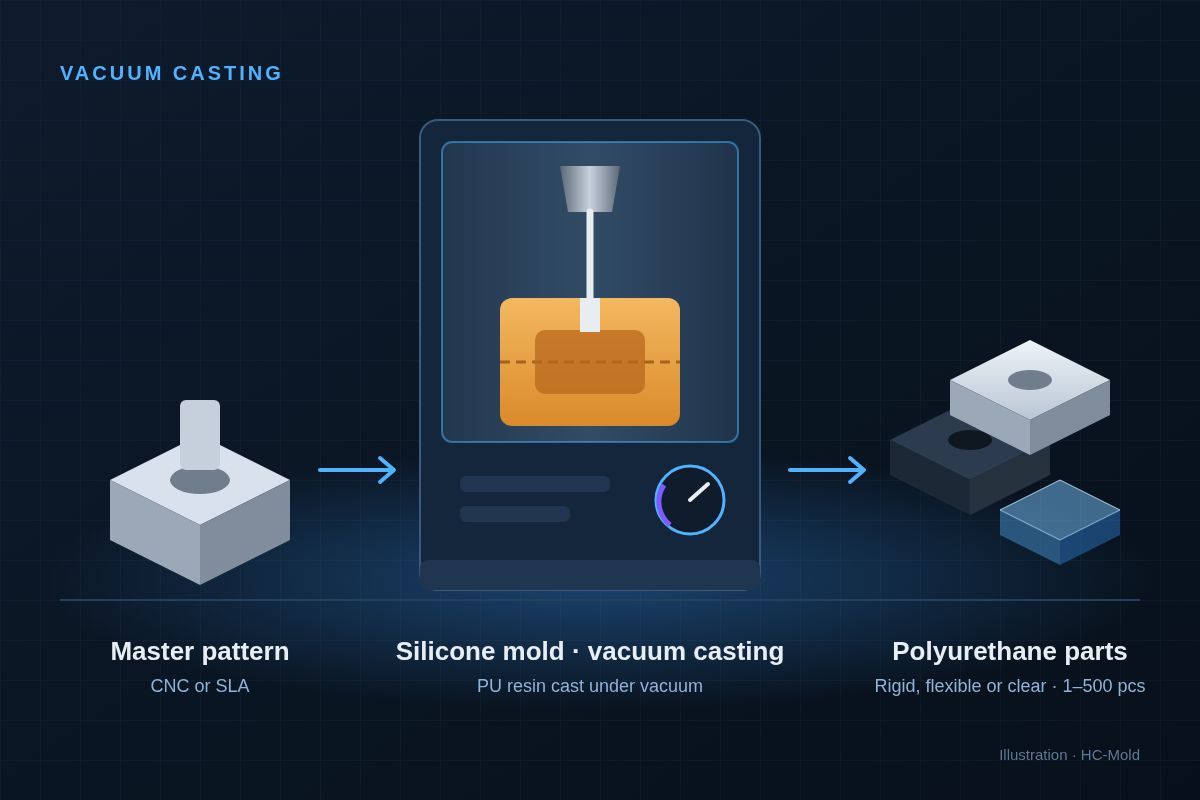
Vacuum casting (also called urethane casting or polyurethane casting) copies a master part into a soft silicone mold, then fills the mold with liquid resin in a vacuum chamber so the parts come out without air bubbles.
Master pattern
A master part is CNC machined or SLA printed from your CAD and finished to the surface you want on the cast parts.
Silicone mold
Liquid silicone is poured around the master and cured. The mold is cut open along a parting line and the master removed.
Casting under vacuum
Polyurethane resin is mixed, degassed and poured into the closed mold under vacuum, then cured in an oven.
Finishing & inspection
Parts are demolded, trimmed, painted or printed as required, inspected and packed.
A silicone mold typically produces around 15–20 castings, so larger quantities are cast from several molds made from the same master.
Cast urethane materials
Polyurethane casting resins simulate the look and behavior of common production plastics. We confirm the grade in the quote against your test requirements.
| Resin type | Simulates | Typical parts |
|---|---|---|
| Rigid polyurethane | ABS, PP, PC | Housings, enclosures, covers, brackets |
| Flexible polyurethane | Rubber, TPE, silicone | Seals, grips, gaskets, soft-touch parts |
| Clear polyurethane | PMMA, PC | Lenses, light guides, transparent covers |
When to choose vacuum casting
General guidance; we recommend a route in the quote based on quantity, material and how close the parts must be to production.
| Process | Best for | Quantity | Lead time |
|---|---|---|---|
| 3D printing (SLA, SLS, MJF) | Fast concept and fit models | 1–10 | 2–3 days |
| CNC machining | Functional parts in the production material | 1–50 | 3–5 days |
| Vacuum casting | Molded look and feel, colors, soft-touch, small series | 10–500 | 5–7 days |
| Rapid tooling and injection molding | Parts in the real production resin | 500+ | About 15 days for the tool |
More detail: SLA vs SLS vs MJF · rapid tooling vs a production mold · MOQ by process
Examples of prototypes
Prototypes of the type we make by vacuum casting, CNC machining and 3D printing. See all rapid prototyping services.
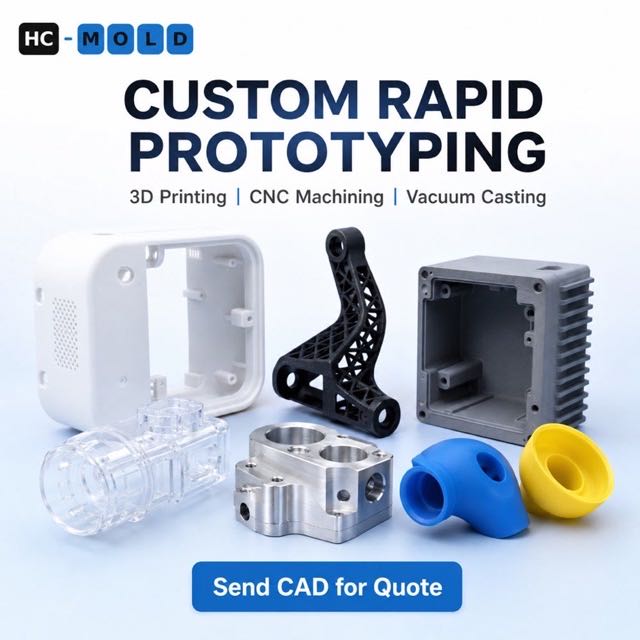
Rapid Prototype Parts by 3D Printing, CNC and Vacuum Casting

Desk Phone Housing and Keypad Prototype

Laptop Housing Prototype in Plastic and Aluminum
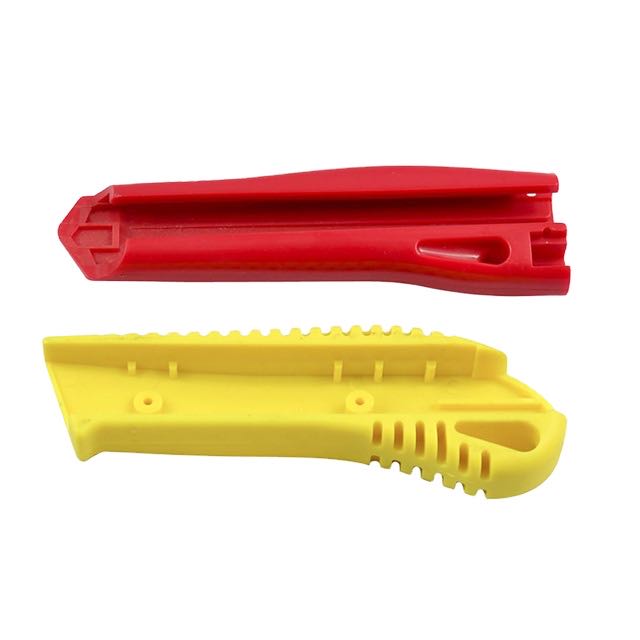
Plastic Utility Knife Handle Prototypes
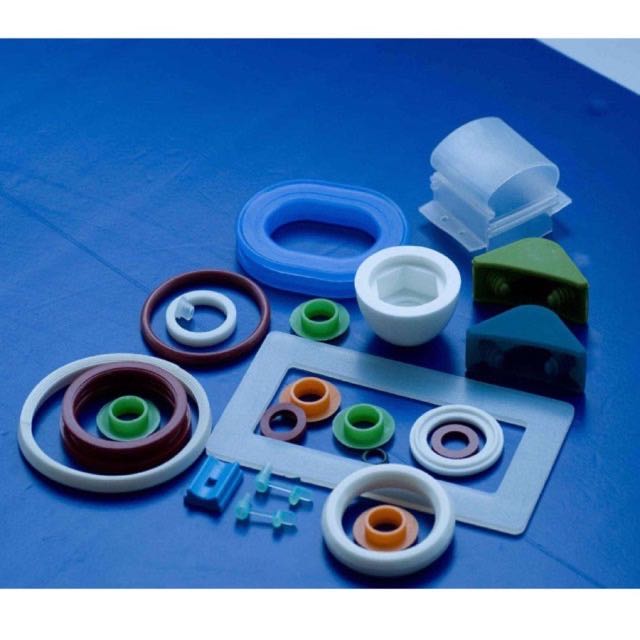
Silicone and Rubber Prototype Parts
From cast parts to production
Vacuum cast parts are often used for user trials, certification samples and pilot sales while the production mold is built. The injection mold and production molding are made in the same factory, so the design you validated carries straight into production. Read prototype to production in the same factory.
Vacuum casting FAQ
What is vacuum casting?
A low-volume process that copies a master part into a silicone mold and casts polyurethane parts in it under vacuum. It produces parts that look and feel like injection molded parts without the cost of a steel or aluminum mold.
How many parts can you make by vacuum casting?
From 1 to about 500. A silicone mold typically gives around 15–20 castings, so larger quantities use several molds. Above a few hundred parts, rapid tooling and injection molding are usually cheaper per part.
How long does vacuum casting take?
5–7 days for the first parts, depending on size, quantity and finishing. Rush service is available.
What is the difference between vacuum casting and vacuum forming?
Vacuum casting pours liquid resin into a silicone mold to make solid 3D parts. Vacuum forming heats a plastic sheet and pulls it over a mold, which suits thin trays and covers. This page covers vacuum casting.
Which materials can be vacuum cast?
Polyurethane resins in rigid grades that simulate ABS, PP or PC, flexible rubber-like grades, and clear grades for lenses and covers. Tell us the properties you need and we recommend a grade.
Can cast urethane parts be painted or colored?
Yes. Resin can be pigmented to color, and parts can be painted, plated or screen printed.
Will you sign an NDA before I send drawings?
Yes. A confidentiality agreement is signed before any file review. See IP protection and NDA.
Get a vacuum casting quote
From 1 piece · 5–7 days · NDA before file review · reply ≤12h · quote ≤24h on complete RFQ · ISO 9001:2015