
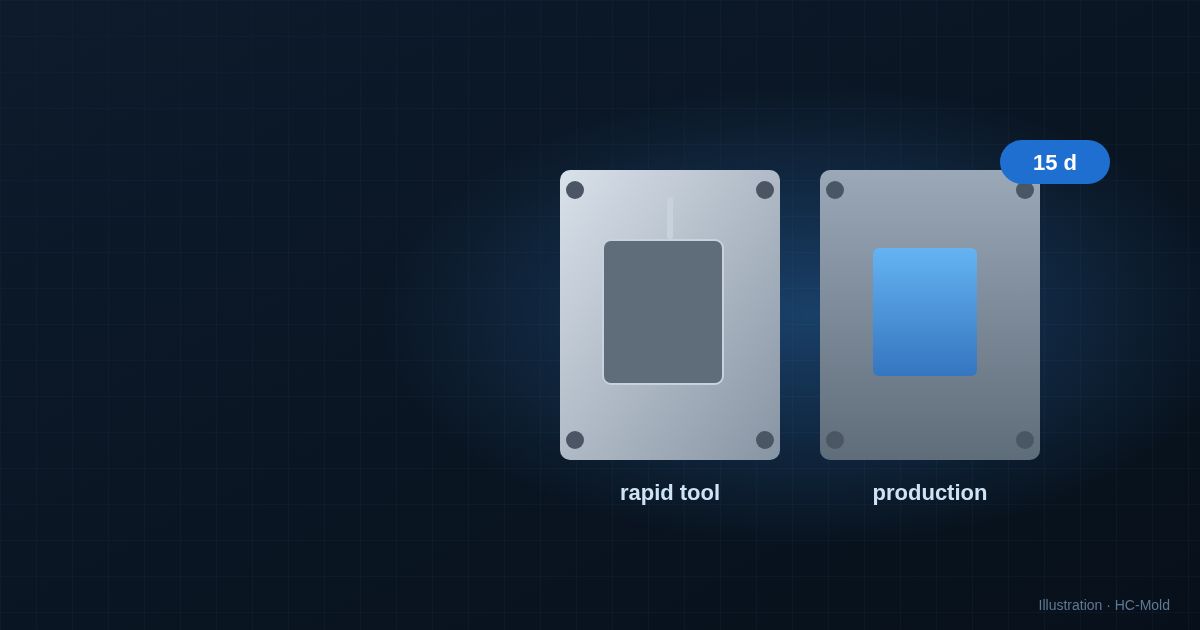
An aluminum or rapid prototype mold costs roughly $300–1,500 and suits sampling and small validation runs, but its life is short and it cannot replace a production mold. A steel production mold starts at about $1,200–4,000 for a simple single-cavity tool and $4,000–10,000 for a typical housing with slides. HC-Mold builds rapid tooling in about 15 days and standard molds in 25–35 days.
Illustrative scenario (not a customer project): a team has a launch date 12 weeks away and a design that has only been tested in prototypes. A hardened steel production mold may take longer than the schedule allows, and a design flaw found after steel is cut is expensive to fix. A faster tool for early production could solve both problems. This guide shows how to decide.
Quick answer
Build rapid tooling first when you need parts quickly, the design is not yet proven, or demand is uncertain. Build a production mold first when the design is frozen, volume is high and stable, the resin is demanding or the specification is tight. HC-Mold's rapid tooling takes about 15 days, and a standard mold takes 25 to 35 days. Many programs use both: a rapid tool to validate and launch, then a production mold to scale.
Aluminum vs steel injection molds
"Rapid tooling" usually means one of two things: a mold machined from aluminum, or a simplified mold in pre-hardened steel with fewer mechanisms. Both are faster and cheaper than a full production mold. The table uses HC-Mold reference prices (FOB China).
| Aluminum / rapid prototype mold | Pre-hardened steel (P20, 718H) | Hardened or stainless steel (H13, S136) | |
|---|---|---|---|
| Typical use | Sampling, design validation, small trial runs | Most production molds, pilot and launch volumes | High volumes, glass-filled or corrosive resins, mirror finishes |
| Reference price | About $300–1,500 | From about $1,200–4,000 (simple single cavity) | Higher: S136 adds roughly 40–80% over P20 |
| Mold life | Short; not a production mold | 300,000+ shots warranty at HC-Mold | Up to about 1,000,000 cycles |
| Changes | Easy and cheap to modify | Possible; welding and re-machining | Costly once hardened |
| Limits | Abrasive or glass-filled resins wear it quickly; limited cooling and mechanisms | Balanced | Longest lead time and highest cost |
A practical rule: use an aluminum mold when you need tens to a few hundred parts in the real resin to test the design; use pre-hardened steel when the design is close to final and you expect to keep producing; use hardened or stainless steel when volume, resin or finish demands it. For full price ranges by mold type, see how much does an injection mold cost?
Side-by-side comparison
| Rapid tooling | Production mold | |
|---|---|---|
| Lead time at HC-Mold | About 15 days | 25 to 35 days |
| Typical construction (general guidance) | Simpler or softer construction, often aluminum or pre-hardened steel | Hardened or high-grade tool steel, fuller cooling and mechanisms |
| Upfront cost | Aluminum about $300–1,500 | From about $1,200 (simple steel mold) |
| Expected life | Shorter; confirm in your quote | Longer; HC-Mold's mold warranty is 300,000+ shot cycles |
| Design changes | Easier and cheaper to modify | Costly to change once hardened |
| Resin compatibility | Check for abrasive or filled resins | Suited to demanding resins |
| Surface finish and tolerance | Good for validation; check limits | Best for tight tolerances and cosmetic textures |
| Cost per part at high volume | Higher | Lower |
| Best for | Validation, pilot runs, short runs, bridge supply | Mass production |
Details such as tool material, shot life and resin limits depend on the project, so confirm them in writing. For how steel choice affects life and polish, see P20 vs H13.
Decision rules
- The design is not proven: build rapid tooling. Finding a problem in a softer tool is cheaper than in hardened steel.
- Volume is uncertain or low: rapid tooling usually fits. If your quantity is below the injection MOQ, see MOQ by process.
- Launch date is close: run a rapid tool first, and cut the production mold in parallel as the scale-up tool. The rapid tool covers early demand.
- Annual volume is high and stable: build the production mold. Lower cost per part pays back the tooling.
- The resin is glass-filled or abrasive: use hardened steel and confirm resin compatibility with engineering.
- Tight tolerance, high polish or texture is required: a production mold gives the most control.
- The product is cosmetic or branded: validate appearance with the rapid tool, then decide whether the same finish can be held in production.
The two-step path
Many programs run in two phases:
- Prototype with CNC, vacuum casting or 3D printing to prove form and function.
- Rapid tool for pilot and early market volume, and to validate DFM.
- Production mold once the design is frozen and volume is justified.
Keeping all three steps in one factory preserves datums, DFM changes and inspection plans. See prototype to production in the same factory.
What changes when you move from rapid to production tooling
Treat the production tool as a new validation, not a copy:
- Cooling and cycle time may differ.
- Shrinkage, warpage and cosmetic results may shift slightly.
- Sample approval (T1) is needed again. See the sample process.
- Reuse of design data and learned DFM changes should be agreed with engineering.
Common mistakes
- Assuming a rapid tool has the same life, resin range and tolerance as a production mold
- Skipping DFM because the tool is "only temporary"
- Locking the production design before rapid-tool results are reviewed
- Ignoring cooling and cycle time when moving to production
- Not planning storage, ownership and transfer terms for either tool
Cost and ownership
Rapid and production tools can both be bought under HC-Mold's tooling models: you pay and own the mold (Model A), HC-Mold funds the tool and keeps ownership (Model B), or you prepay and the tooling cost is refunded from product payments when cumulative deliveries reach the contracted quantity (Model C). Read who owns the mold and how injection mold cost is built up before deciding.
What to send for a recommendation
STEP/IGES model and PDF drawing, resin and color, planned volume for the first 12 months and the long term, target launch date, surface finish or texture, tolerance-critical features and whether you may move production later. HC-Mold's free DFM review is part of the mold project, and the plastic part DFM checklist helps you prepare.
FAQ
How long does rapid tooling take compared with a production mold?
About 15 days for rapid tooling and 25 to 35 days for a standard mold at HC-Mold. Your timeline is confirmed before order placement.
How many parts can a rapid tool make?
It depends on the tool material, resin and part. Confirm the expected life in your quote.
Can I use a rapid tool for mass production?
Usually not. Rapid tooling is designed for validation, pilots and shorter runs. Discuss expected volume and resin with engineering.
Will the production mold be a new build?
In most programs, yes. Design data and DFM learnings carry over, but the production tool is validated again.
Is the DFM review free?
Yes, free DFM review, mold-flow analysis, T0 trial and modification are included in the mold project.
Not sure which tool to build first?
Send your drawing, resin and first-year volume. We will recommend a tooling route under NDA.
Written by HC-Mold Engineering Team · Reviewed by HC MOLD · Last updated: 2026-11-01
Talk to HC-Mold engineering
Free DFM · reply ≤12h · quote ≤24h on complete RFQ · ISO 9001:2015 · Dongguan, China