
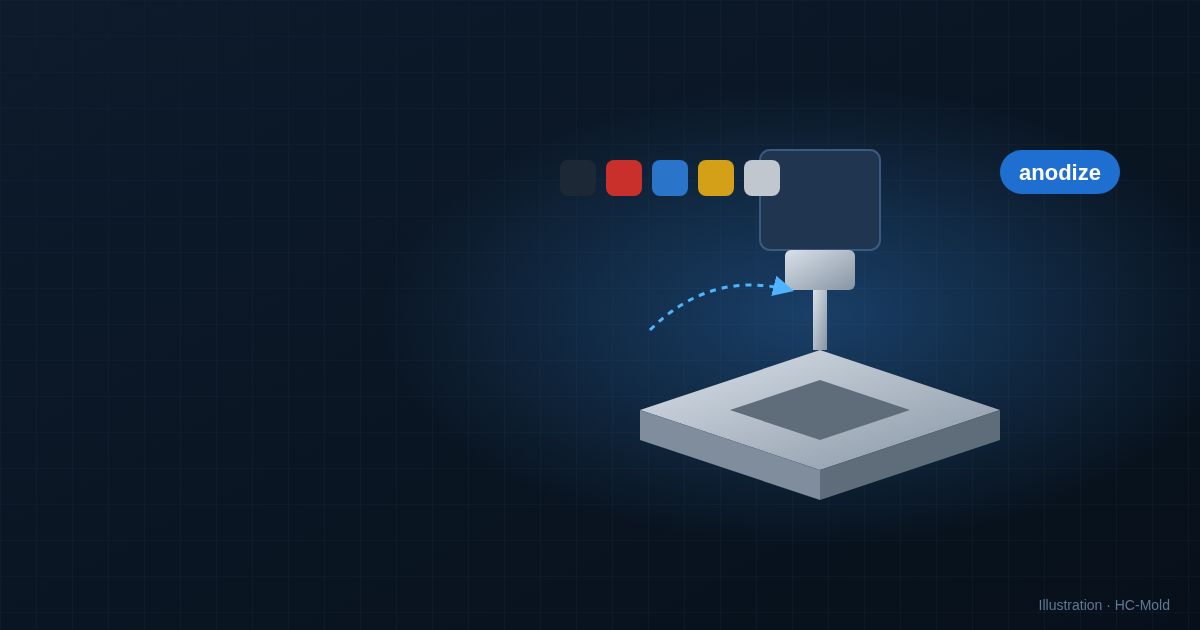
Anodizing is an electrochemical process that turns the surface of aluminum into a hard, corrosion-resistant layer of aluminum oxide. The part is made the anode in an acid bath, and current grows the oxide out of the metal itself, so it cannot peel like paint. Type II (sulfuric) anodizing is used for colored and cosmetic parts; Type III hard anodizing gives a thicker, wear-resistant layer; Type I (chromic) is a thin layer used mainly in aerospace.
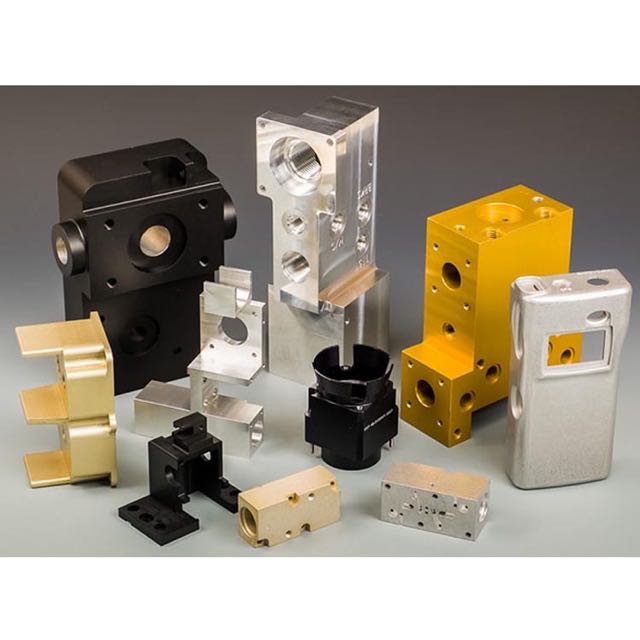
Most of the aluminum parts we CNC machine leave the factory anodized: housings, heat sinks, brackets and prototype parts in black, clear, gold and custom colors. This guide explains how anodizing works, which type to specify, which alloys anodize well, and the design and drawing details that decide whether a batch of anodized parts comes back right the first time.
How anodizing works
The aluminum part is hung on a rack, which also carries the electric current, and lowered into an electrolyte, usually sulfuric acid. The part is the anode, and a direct current grows a layer of aluminum oxide from the surface. The layer is porous when it forms, so it can absorb dye, and it is then sealed to close the pores and lock in color and corrosion resistance.
Because the oxide grows from the metal itself, roughly half of the coating thickness penetrates into the original surface and half builds up above it. That is why anodizing changes dimensions, and why the coating is far better bonded than paint or powder coat.
The anodizing process step by step
- Pre-finish: machining marks are left as cut, or the surface is bead blasted or brushed for a uniform matte or satin look.
- Racking: parts are fixed on titanium or aluminum racks. The contact points stay uncoated, so rack mark positions are agreed in advance.
- Cleaning and etching: degreasing and a light etch remove oil and give an even surface; chemical brightening is used for a glossy finish.
- Anodizing: current is applied in the acid bath until the specified thickness is reached.
- Dyeing: parts are dipped in dye while the pores are open (skipped for clear anodizing).
- Sealing: hot water or a nickel-based seal closes the pores.
- Inspection: color, appearance, coating thickness and critical dimensions are checked against the agreed standard.
Types of anodizing: Type I, II and III
The types come from the US military specification MIL-A-8625, which is still the common reference on drawings.
| Type | Electrolyte | Typical thickness | Used for |
|---|---|---|---|
| Type I | Chromic acid | Thin, under about 7 µm | Aerospace parts, fatigue-sensitive parts, paint base |
| Type II | Sulfuric acid | About 5–25 µm | Colored and cosmetic parts: enclosures, consumer products, heat sinks |
| Type III (hard anodizing) | Sulfuric acid, low temperature, high current | About 25–75 µm | Wear surfaces, sliding parts, pistons, tooling, harsh environments |
Type II is the default for most parts. Hard anodizing is harder and more wear-resistant, but it is darker (grey to bronze on most alloys), takes dye less evenly and costs more. Of the recent RFQs sent to us that mention anodizing, five of eight asked for hard anodizing, so it is worth deciding early whether wear resistance or appearance matters more.
Which aluminum alloys anodize best?
| Alloy | Anodizing result |
|---|---|
| 6061-T6 | Very good; the most common choice for machined parts, even color |
| 6063 | Excellent cosmetic result; common for extrusions |
| 7075-T6 | Good, but the color can differ from 6061 in the same assembly; clear anodize may look slightly yellow |
| 5052 | Good; mostly sheet parts |
| 2024 | Fair; the copper content gives a thinner, less protective, sometimes uneven layer |
| Die-cast alloys (ADC12, A380) | Poor; high silicon gives a grey, blotchy surface, so die-cast parts are usually painted or powder coated instead |
If parts from different alloys sit side by side in one product, ask for color samples of each, or keep cosmetic parts in one alloy. Welded areas also anodize differently from the base metal.
Colors and appearance
- Clear (natural): keeps the metallic look; shows machining marks, so pre-finish matters.
- Black: the most requested color for enclosures and optical parts.
- Colors: red, blue, gold, grey and others by dye. Dyes approximate brand colors; approve physical samples rather than relying on a Pantone number.
- Matte vs glossy: bead blasting before anodizing gives matte; brightening or polishing gives gloss.
Color varies with alloy, dye lot, coating thickness and seal. For repeat orders, keep approved master samples at both ends.
Design tips for anodized parts
- Allow for growth: each surface grows by about half the coating thickness, so a bore shrinks and a shaft grows. Specify whether critical dimensions apply before or after anodizing.
- Round sharp edges: coating is thin and can crack on sharp edges; a small radius gives a more durable finish.
- Threads: mask them, cut them after anodizing, or size them for the coating, especially with hard anodizing.
- Electrical contact: anodizing is an insulator; mask grounding pads or machine them after anodizing.
- Blind holes and deep pockets: solution can be trapped and coating may be uneven inside.
- Rack marks: mark on the drawing where small uncoated contact points are acceptable.
- Assemblies: anodize parts before assembly; press-fit inserts and bearings after.
What to put on the drawing
| Callout | Example |
|---|---|
| Specification and type | Anodize per MIL-A-8625 Type II, Class 2 (dyed) |
| Color | Black, matched to approved sample |
| Thickness | For Type III, state the thickness, e.g. 50 µm |
| Pre-finish | Bead blast before anodizing on visible faces |
| Masking | Threads, grounding pads, bearing seats |
| Rack marks | Allowed on non-visible faces only |
| Dimensions | Critical dimensions apply after anodizing |
| Seal | Sealed (default unless bonding or painting follows) |
Can you anodize steel or titanium?
Steel cannot be anodized; it is usually finished with black oxide, zinc or nickel plating, or powder coating. Titanium can be anodized, but in a different way: the color comes from light interference in a thin oxide film, set by the voltage, and is used for identification and appearance rather than hardness. Magnesium can also be anodized with dedicated processes.
What affects anodizing cost?
- Type: hard anodizing costs more than Type II
- Masking: every masked thread or pad adds labor
- Color matching and cosmetic grade
- Pre-finish such as bead blasting or polishing
- Part size and how many parts fit on a rack
- Batch size: small batches carry the set-up cost
We quote anodizing together with the machining, so you get one price and one delivery date. See how much does CNC machining cost?
FAQ
What is anodizing?
An electrochemical process that grows a hard, corrosion-resistant aluminum oxide layer on aluminum parts. The layer can be dyed and is sealed to close its pores.
Does anodizing change part dimensions?
Yes. Roughly half of the coating thickness builds up on each surface, so bores shrink and outside dimensions grow. This matters most with hard anodizing.
What is the difference between Type II and Type III anodizing?
Type II is a thinner sulfuric acid layer used for colored and cosmetic parts. Type III hard anodizing is thicker and harder for wear resistance, darker in color and more expensive.
Can die-cast aluminum be anodized?
It can, but high-silicon die-casting alloys such as ADC12 and A380 give a grey, uneven result, so die-cast parts are usually painted or powder coated.
Can you match a Pantone color with anodizing?
Dyes approximate brand colors. Approve physical color samples, and keep master samples for repeat orders.
Does HC-Mold anodize CNC machined parts?
Yes. Anodizing, including hard anodizing, is quoted together with CNC machining, along with bead blasting, plating, powder coating, passivation and laser marking.
Get anodized parts quoted
Send your STEP file and 2D drawing with alloy, anodizing type, color and masking. We quote machining and finishing together within 24 hours on a complete package. See our CNC machining services.
Written by HC-Mold Engineering Team · Last updated: 2026-11-01
Talk to HC-Mold engineering
Free DFM · reply ≤12h · quote ≤24h on complete RFQ · ISO 9001:2015 · Dongguan, China