
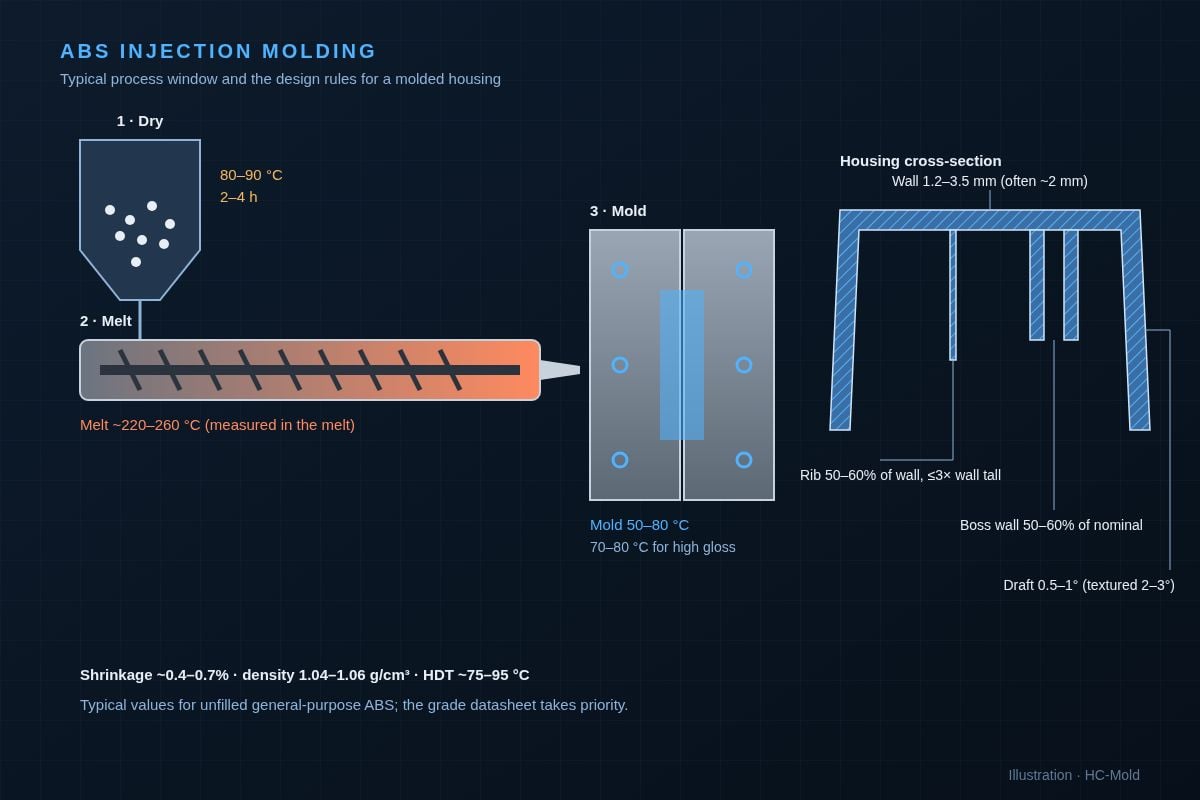
ABS injection molding is the process of melting acrylonitrile butadiene styrene pellets and injecting them into a steel mold to make housings, covers, knobs and trim. Typical settings: dry pellets at 80–90 °C for 2–4 hours, melt at about 220–260 °C, mold at 50–80 °C. Design walls of 1.2–3.5 mm and allow 0.4–0.7% shrinkage.
ABS injection molding is the default route for plastic enclosures because ABS flows easily, shrinks little and predictably, takes a high-gloss or textured finish straight from the mold, and costs less than PC or nylon. It is also easy to get wrong in small ways that show up as splay, sink marks and visible weld lines on a cosmetic face. This guide gives the process window, the design rules, the grades and when to leave ABS for another resin, the mold and cost decisions, and a list of what to put in the RFQ.
Why ABS is the default housing resin
ABS is an amorphous thermoplastic made of three monomers: acrylonitrile for chemical and heat resistance, butadiene rubber for impact toughness, and styrene for stiffness, gloss and easy flow. Changing the ratio gives the grade families below. Because ABS is amorphous, it shrinks less and more evenly than crystalline resins such as POM or PP, which is why flat lids and long snap-fit housings stay flat.
| Property (typical, unfilled) | Value | Design meaning |
|---|---|---|
| Density | 1.04–1.06 g/cm³ | Light; part cost is driven by volume and cycle |
| Tensile strength | ~40–48 MPa | Enough for housings and brackets, not for structural loads |
| Heat deflection, 1.8 MPa | ~75–95 °C | Check parts near lamps, motors or in parked cars |
| Glass transition | ~105 °C | Upper limit even for heat-resistant grades without blending |
| Mold shrinkage | ~0.4–0.7% | Low and nearly equal in all directions |
| Flammability | UL 94 HB (standard); V-0 in FR grades | Electrical enclosures often need the FR grade |
The weak points are just as clear: poor UV resistance, attack by many solvents (acetone dissolves it), and a heat limit below 100 °C. When a requirement hits one of those, switch the resin rather than fighting it in the mold (see section 5).
ABS injection molding process window
These are typical starting values for general-purpose ABS. Every grade has its own datasheet range, and plating, high-heat and flame-retardant grades sit at different points inside it.
| Step | Typical value | What goes wrong outside it |
|---|---|---|
| Drying | 80–90 °C, 2–4 h in a desiccant or hot-air dryer | Wet resin gives silver streaks (splay) and lower impact strength |
| Melt temperature | ~220–260 °C, measured in the melt, not the barrel setting | Too cold: short shots, flow lines. Too hot: yellowing, burn marks, brittle parts |
| Mold temperature | ~50–80 °C; toward 70–80 °C for high gloss | Cold mold: dull surface, visible weld lines, molded-in stress |
| Injection speed | Moderate to fast for thin walls, slower at the gate for cosmetic parts | Jetting and gate blush when too fast; flow lines when too slow |
| Residence time | Keep short; size the shot to 30–80% of barrel capacity | Degradation and black specks from resin sitting in the barrel |
| Regrind | Often limited to 10–25% on non-critical parts | Color shift and impact loss; many cosmetic parts allow none |
Drying is the step most often skipped. ABS picks up moisture from humid air within hours; in a humid climate such as South China in summer, an open bag left at the press can absorb enough to cause splay by the next shift. A hopper dryer at the machine solves it; drying in an oven tray and carrying the pellets across the shop does not.
Design rules for ABS parts
Most ABS problems are fixed on the CAD model, not on the press. These rules suit unfilled general-purpose grades.
| Feature | Typical rule | Reason |
|---|---|---|
| Nominal wall | 1.2–3.5 mm; 2.0–2.5 mm suits most hand-held housings | Thinner walls fill poorly; thicker walls sink and cycle slowly |
| Wall variation | Keep within about ±25% of nominal; blend changes over 3× the step | Abrupt changes cause sink, voids and warpage |
| Ribs | 50–60% of the adjoining wall thick, up to 3× wall tall | Thicker ribs show sink marks on the cosmetic face |
| Bosses | Wall 50–60% of nominal; tie to side walls with ribs | Solid bosses sink and crack when screws are driven |
| Inside radius | At least 0.25–0.5× wall; outside radius = inside + wall | Sharp corners concentrate stress and crack in impact |
| Draft (polished) | 0.5–1° | Less draft scuffs the surface on ejection |
| Draft (textured) | Add about 1° per 0.025 mm of texture depth; 2–3° for most light textures | Texture drags and whitens without enough draft |
| Tolerance | About ±0.1 mm commercial on features under 100 mm; ±0.05 mm on small, well-supported features with tool tuning | Tighter tolerances add tuning loops and cost |
For a full pre-tooling review, use the plastic part DFM checklist. Two points specific to ABS: place gates where the weld line will fall on a hidden face, and keep snap-fit strain under the grade's allowable limit (usually given on the datasheet) because ABS whitens when overstrained.
ABS grades and blends
| Grade family | Pick it when | Watch for |
|---|---|---|
| General purpose (e.g. Chi Mei Polylac PA-757, SABIC Cycolac, INEOS Terluran) | Indoor housings, consumer products | Standard HB flammability only |
| High impact | Tool housings, parts that get dropped | Slightly lower stiffness and gloss |
| Heat resistant | Parts near warm electronics, car interiors | Higher melt temperature; still below ~105 °C |
| Flame retardant (UL 94 V-0) | Mains-powered electrical enclosures | Narrower process window; corrosive if overheated |
| Plating grade | Chrome-look knobs, trim, badges | Mold temperature and gate position control plating adhesion |
| Transparent ABS (MABS) | See-through covers that need toughness | Not as clear as PC or PMMA |
| Glass filled (10–30%) | Stiffer brackets and frames | Shrinkage drops to ~0.1–0.2%; surface shows fibers; abrasive to steel |
Name the grade and producer on the drawing. "ABS, black" will be quoted on the cheapest general-purpose resin available that week, and a later lot may come from a different producer with a different shrinkage and color.
When to choose PC/ABS, PC, ASA or PP instead
| Requirement | ABS? | Better choice |
|---|---|---|
| Outdoor exposure, color must hold | Poor UV resistance | ASA, or UV-stabilized PC/ABS |
| Heat above ~90 °C, or higher impact at low temperature | At the limit | PC/ABS (HDT around 100–110 °C) or PC |
| Clear part | Only MABS | PC for toughness, PMMA for clarity |
| Living hinge, chemicals, lowest cost | Not suitable | PP |
| Gears, slides, wear | Wears fast | POM; see the Delrin (POM) guide |
| Contact with solvents, fuels, some cleaners | Stress cracks | PP, PA or PBT |
For electronics enclosures, PC/ABS is the usual upgrade: same tooling approach, similar shrinkage (about 0.5–0.7%), better heat and impact. An ABS mold can often run PC/ABS after a trial, but confirm the shrinkage of the new grade before committing to tight tolerances. The plastic material selection guide covers the rest of the field.
Molds for ABS: steel, finish and cost
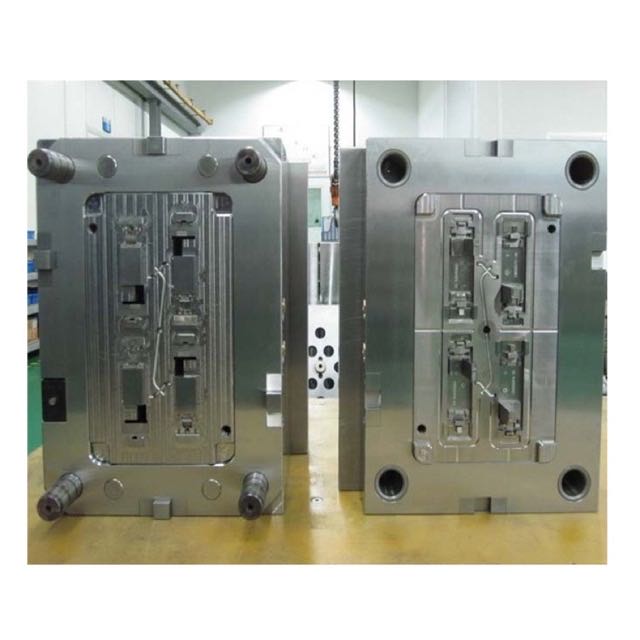
Unfilled ABS is not abrasive or corrosive, so mold steel is chosen by shot volume and surface finish:
- 718H (pre-hardened P20 type): the right call for most ABS housings. Machines well and polishes to a good gloss. HC-Mold production molds carry a 300,000+ shot warranty.
- NAK80: for high-gloss cosmetic faces and fine textures.
- S136 stainless (420 type): for mirror finishes, flame-retardant ABS, or humid storage between runs. It costs about 40–80% more than P20.
- Hardened steel: for glass-filled ABS or volumes approaching 1,000,000 cycles.
Surface finish is specified per face: an SPI polish grade (A-1 to D-3) or a texture standard. ABS reproduces both well, which is one reason it dominates consumer housings. Plan textures before steel is cut, because they set the draft.
Reference mold prices (FOB China, not quotes): a simple single-cavity ABS mold runs about $1,200–4,000; with slides or lifters $4,000–10,000; multi-cavity, hot-runner or cosmetic tools $10,000–30,000. An aluminum prototype mold costs about $300–1,500 but has a short life. Standard molds reach T1 samples in 25–35 days, rapid tools in about 15 days. The injection mold cost guide explains the adders, and hot runner vs cold runner covers the runner choice, which matters for color changes in ABS.
Secondary operations are common on ABS and are worth quoting with the molding: painting, screen printing, laser engraving, vacuum plating, ultrasonic welding, insert installation and sub-assembly. TPE overmolding works well because many TPE grades are formulated to bond to ABS; see overmolding vs insert molding.
Common ABS defects and quick causes
| Defect | Most likely cause in ABS | First fix |
|---|---|---|
| Silver streaks (splay) | Moisture | Dry 80–90 °C for 2–4 h at the press |
| Sink marks | Thick ribs or bosses | Core out; ribs to 50–60% of wall |
| Visible weld line | Cold melt front meeting on a cosmetic face | Move the gate, raise mold temperature, add venting |
| Yellowing or burn marks | Melt too hot, long residence, trapped gas | Lower melt temperature, smaller barrel, vent the end of fill |
| Stress whitening | Ejection drag or overstrained snap fits | More draft, polish, change snap geometry |
| Gloss variation | Uneven mold temperature | Balance cooling circuits |
The injection molding defects guide covers these and others in more depth.
What to put in the RFQ for ABS parts
In the 109 website RFQs and emails we analyzed from August to October 2026, ABS was named in only two, and neither gave a grade or producer. The supplier then picks, and the quote you compare may be for a different material from the one you tested. Include:
- Resin: producer and grade (or "equivalent approved by buyer"), color with a Pantone or RAL reference or a color master, and flame rating if needed.
- Cosmetic faces and their finish: SPI grade or texture code, and where gate, ejector and weld marks are allowed.
- Critical dimensions and a general tolerance; mating parts in the same assembly.
- Annual volume and lot size (our typical MOQ is 500–1,000 parts per run).
- Secondary operations, inserts, packaging, and compliance documents such as RoHS.
- Mold expectations: cavities, steel, shot life, and who owns the tool.
The injection mold RFQ checklist has the full list.
FAQ
What temperature is ABS injection molded at?
Typically a melt temperature of about 220–260 °C and a mold temperature of 50–80 °C. High-gloss parts run toward the upper end of the mold range. Use the datasheet of the exact grade, since heat-resistant and flame-retardant grades differ.
Does ABS need to be dried before molding?
Yes. ABS absorbs moisture from the air, and wet resin causes silver streaks and lower impact strength. Dry it at about 80–90 °C for 2–4 hours in a dryer at the press, and do not leave dried pellets open to humid air.
What is the shrinkage of ABS?
About 0.4–0.7% for unfilled grades, and roughly 0.1–0.2% for glass-filled ABS. It is lower and more uniform than crystalline resins such as POM or PP, so ABS parts hold flatness and size well.
Can ABS parts be used outdoors?
Not for long without protection. UV light fades and embrittles standard ABS. Use ASA, a UV-stabilized PC/ABS, or paint the part for outdoor use.
How long does an injection mold for ABS last?
It depends on the steel. A pre-hardened steel mold such as 718H typically lasts several hundred thousand shots, and HC-Mold warrants 300,000+ shots. Hardened steel molds reach about 1,000,000 cycles. Aluminum prototype molds are for short runs only.
Can ABS be chrome plated?
Yes. ABS is the most common resin for decorative electroplating. Specify a plating grade, keep weld lines and gate marks off plated faces, and tell the molder the part will be plated so mold temperature and gating are set for adhesion.
Get an ABS part reviewed
Send your STEP file, drawing, grade and annual volume. We return a free DFM review with gate, draft and wall comments, and quote the mold and parts within 24 hours on a complete RFQ. See our injection molding services and injection mold making.
Written by HC-Mold Engineering Team · Last updated: 2026-11-09
Talk to HC-Mold engineering
Free DFM · reply ≤12h · quote ≤24h on complete RFQ · ISO 9001:2015 · Dongguan, China