
Delrin is the trade name of an acetal homopolymer (POM-H), a stiff, low-friction engineering plastic used for gears, bushings, rollers, clips and precision machined parts. Generic "acetal" usually means acetal copolymer (POM-C): about 10–15% less strong and stiff, but better in hot water and chlorine, with less centerline porosity in thick stock and a lower price.
Delrin plastic is the material engineers reach for when a part has to slide, snap or mesh without lubrication and still hold its size. It is polyoxymethylene (POM), sold under the Delrin® name as a homopolymer, while most other acetal brands are copolymers. The two behave alike on most drawings but differ in strength, heat resistance, porosity and price. This guide covers the property data, how Delrin differs from acetal copolymer, which grade to use, how to machine and mold it, where it fails, and what to write on the drawing so the supplier buys the material you meant.
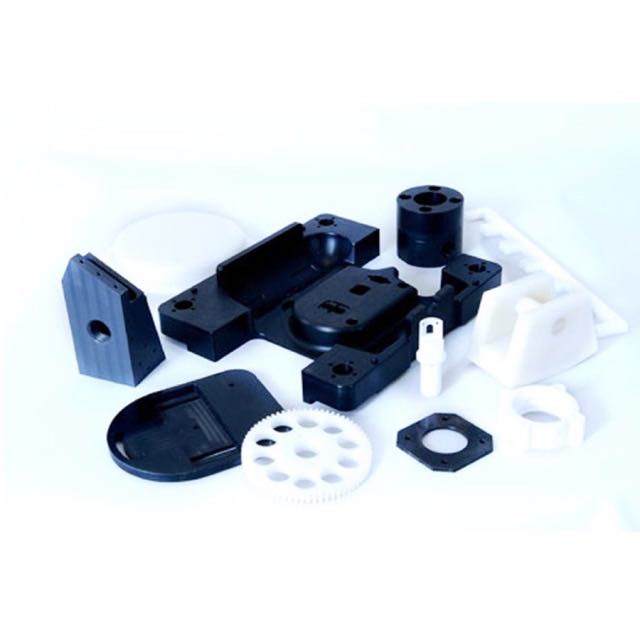
What Delrin plastic is
Delrin is a semi-crystalline thermoplastic made of repeating –CH₂O– units, the polymer form of formaldehyde. "Delrin" is a brand, originally developed by DuPont, for the homopolymer version. The generic names are acetal, polyacetal and POM. Producers also make a copolymer, POM-C, in which a small amount of a second monomer is built into the chain every 70–100 units. That interruption is what makes the copolymer more stable in hot water and alkaline cleaners, and slightly less strong.
- POM-H (homopolymer): Delrin. Higher crystallinity, higher strength and stiffness, higher short-term heat deflection.
- POM-C (copolymer): sold as Celcon, Hostaform, Duracon and many generic grades from Asian producers. When a drawing or a supplier says just "POM" or "acetal", it is usually copolymer.
The material is specified in the US under ASTM D6778 (classification of POM molding and extrusion materials). Property values below are measured to ASTM D638 (tensile) and D648 (heat deflection).
Delrin properties at a glance
The table gives typical stock-shape values for unfilled grades. Datasheets for a given lot will differ slightly, so design to the datasheet of the grade you actually buy.
| Property (typical) | Delrin 150 (POM-H) | Acetal copolymer (POM-C) | What it means for the part |
|---|---|---|---|
| Tensile strength | ~76 MPa (11,000 psi) | ~65 MPa (9,500 psi) | Strong enough to replace die-cast zinc or brass in lightly loaded parts |
| Tensile modulus | ~3.1 GPa | ~2.8 GPa | Stiffer than nylon or PP; snap fits need shorter deflection |
| Elongation at break | 25–30% | ~30% | Tough at room temperature; notches still crack it |
| Heat deflection, 1.8 MPa | ~121 °C (250 °F) | ~104 °C (220 °F) | Short-term heat only |
| Continuous use temperature | ~80–90 °C | Long-term limit for loaded parts | |
| Density | 1.41–1.42 g/cm³ | About half the weight of aluminum | |
| Friction against steel | ~0.1–0.3 (dry) | Runs without grease in many gear and slide uses | |
| Thermal expansion | ~100–120 µm/m·K | About five times aluminum; matters for tolerances | |
| Mold shrinkage | ~1.8–2.5% | High; mold design must allow for it | |
| Flammability | UL 94 HB | No V-0 grade in standard acetal | |
Thermal expansion and shrinkage cause most of the trouble on drawings. A 100 mm POM part grows about 0.11 mm when it warms by 10 °C. A tolerance of ±0.02 mm on that length means nothing unless the drawing also states the measuring temperature, normally 20 °C per ISO 1.
Acetal vs Delrin: which one to specify
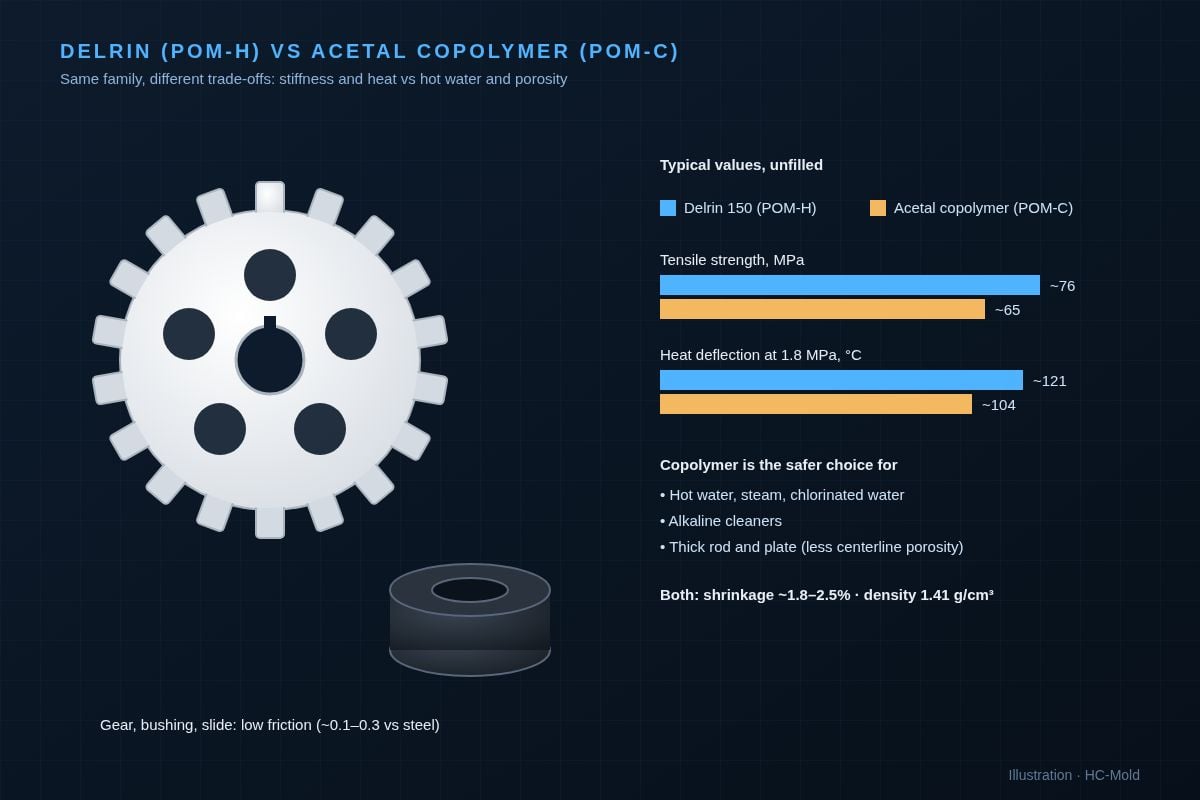
Acetal vs Delrin is a choice between a homopolymer and a copolymer, not between a good material and a cheap copy. Both machine well, both have low friction and low moisture uptake, and both are available in food-contact grades. The differences decide the choice only at the edges.
| Requirement | Choose | Why |
|---|---|---|
| Highest stiffness or strength in a thin section | Delrin (POM-H) | 10–15% higher strength and modulus |
| Short heat spikes above 100 °C | Delrin (POM-H) | Higher heat deflection temperature |
| Hot water, steam, dishwasher or chlorinated water | Copolymer (POM-C) | Better resistance to hydrolysis and chlorine |
| Alkaline cleaners (high pH) | Copolymer (POM-C) | More stable chain end groups |
| Thick plate or large-diameter rod, pressure-tight or food parts | Copolymer (POM-C) | Much less centerline porosity in thick stock |
| General gears, bushings, clips at room temperature | Either | Performance difference is rarely measurable in service |
| Lowest material cost | Copolymer (POM-C) | Commodity pricing, many producers |
Our view: for most machined parts, specify "POM-C, natural or black" and keep Delrin for parts where the extra 10–15% stiffness or the higher heat deflection is actually used. If a part is cut from large-diameter rod or thick plate and the core ends up in a sealing face or a food-contact surface, copolymer is the safer choice because homopolymer stock is more likely to have a porous center.
Delrin grades and what the numbers mean
Delrin molding grade numbers follow melt viscosity: the lower the number, the stiffer the melt and the tougher the part. Letters add a modifier.
| Grade | Type | Use it for |
|---|---|---|
| 100 series | High viscosity | Highest toughness and fatigue life: gears, clips under repeated load |
| 500 series | Medium viscosity | General-purpose molding |
| 900 series | High flow | Thin walls and long flow lengths, multi-cavity molds |
| 150 | Extrusion grade | Rod, plate and tube for machining |
| 570 / glass filled | 20% glass | Higher stiffness and lower creep; more abrasive, lower friction benefit |
| AF | PTFE filled | Lowest friction and wear for unlubricated bearings |
| ST / T suffix | Impact modified | Snap fits and parts that see impact; lower stiffness |
| UV suffix | UV stabilized | Parts exposed to daylight |
Copolymer producers use their own codes, usually based on melt flow index. Ask the supplier to name the grade on the quote, not just "POM".
How to machine Delrin
Delrin is one of the easiest plastics to CNC machine: clean cuts, short chips, few burrs. The limits come from heat and stress, not cutting forces.
- Sharp tools with positive rake. Use polished-flute carbide or HSS tools reserved for plastics. A dull edge rubs, heats the surface above about 90 °C, and the material smears.
- Clear the chips. Air blast or coolant keeps chips from re-cutting and melting into deep pockets and drilled holes.
- Hold gently. Clamping pressure distorts thin walls; the part springs back after release. Use soft jaws, vacuum or full-support fixtures for plates.
- Rough, rest, finish. Extruded stock carries internal stress. On large or asymmetric parts, rough-machine, leave stock, let the part rest or anneal it, then finish. This keeps flatness on long plates.
- Measure at temperature. Let parts reach room temperature before final inspection; a freshly cut part reads large.
Design rules that keep a POM part cheap:
- Tapped threads in POM hold for occasional assembly. For screws removed often, specify threaded inserts.
- Inside corners: give a radius at least the size of a standard end mill, 1 mm or more where you can.
- Avoid sharp notches at snap-fit roots. POM is tough, but a sharp notch is where it cracks.
- Apply tight tolerances only to fits, bores and gear geometry; leave the rest to ISO 2768-m. See CNC machining tolerances.
At HC-Mold, POM is one of the 50+ materials we machine on 3-, 4- and 5-axis mills, CNC lathes and Swiss-type lathes. CNC prototypes typically ship in 3–5 days and production lots in 5–10 days.
Injection molding Delrin
Acetal molds fast and precisely but forgives less than ABS or PP. Values below are typical; the supplier's molding guide for the grade takes priority.
| Setting (typical) | Value | Note |
|---|---|---|
| Melt temperature | ~190–230 °C (homopolymer often ~215 °C) | Above about 230 °C the polymer starts to break down |
| Mold temperature | ~80–100 °C | Hotter molds give higher crystallinity and less post-mold shrinkage |
| Shrinkage | ~1.8–2.5% | Higher in thick walls and in the flow direction |
| Drying | Usually not needed for fresh, sealed resin | Dry if bags were opened or the supplier specifies it |
- Decomposition is the main hazard. Overheated or overstayed POM depolymerizes and releases formaldehyde gas. Keep residence time short, vent the mold well, and purge before shutdowns.
- Never run POM after PVC without purging. Traces of PVC in the barrel can trigger rapid acetal decomposition. Good shops purge with PE or PP between the two.
- Mold steel. Decomposition products are corrosive. For long-running POM tools, a stainless mold steel such as S136 (420 type) or a hard-chromed cavity holds up better than P20. See P20 vs H13 mold steel.
- Design for the shrinkage. Keep walls uniform, core out thick bosses, and gate into the thickest section so it packs out. Sink marks in POM come from thick sections more often than from settings.
- Gears. Tooth profiles must be cut with POM shrinkage built in, then corrected after T1 samples are measured. Plan one steel-safe correction loop in the schedule.
Our standard molds take 25–35 days to T1 samples, with a dimensional report on the samples, and rapid tools take about 15 days. Steel options include P20, 718H, NAK80 and S136 stainless. Read how much an injection mold costs for price ranges.
Where Delrin is the wrong choice
| Condition | Problem with POM | Usually better |
|---|---|---|
| Continuous use above ~90 °C | Creep and loss of strength | PPS, PEEK, glass-filled PA66 |
| Outdoors without UV grade | Surface chalking and embrittlement | UV-stabilized POM, ASA, PA with UV package |
| Strong acids, chlorine bleach | Chemical attack (worse for homopolymer) | PP, PVDF, POM-C for mild exposure |
| Parts that must be glued or painted | Very low surface energy; adhesives do not hold | ABS, PC, or design a snap fit or weld |
| Flame rating V-0 required | Standard acetal is HB only | FR PC, FR PBT, FR PA |
| High impact at low temperature | Toughness drops below freezing | Impact-modified POM, PC, PA |
Against nylon (PA6/PA66), Delrin absorbs far less water, so it holds dimensions in humid air, and it is stiffer and slipperier. Nylon tolerates higher temperatures, takes impact better and accepts glass reinforcement more readily. For a gear in a humid environment, POM is usually the better call. For a structural bracket near a motor, glass-filled PA66 is. The plastic material selection guide compares the other common resins.
What to put on the drawing and RFQ
Of the 109 website RFQs and emails we analyzed from August to October 2026, 25 mentioned plastic parts, yet only one named POM and none gave a specific acetal grade. If the drawing says "plastic, white", the supplier will choose, and the cheapest stock wins. State it instead:
- Material: "POM-C, natural" or "Delrin 150, black, no substitution". If you need the brand, say so and ask for the material certificate.
- Food or medical contact: name the regulation (for example FDA 21 CFR 177.2470 for copolymer or 177.2480 for homopolymer) and ask for the compliance statement for the exact grade.
- Critical dimensions with the measuring temperature, and a general tolerance for the rest.
- Surface finish on running faces in Ra, and any cosmetic faces. See the surface roughness chart.
- Quantity: prototype and annual volume. Under a few hundred pieces, machining from stock is usually cheaper than a mold; above that, compare. Read CNC vs injection molding for low volume.
Every incoming lot at HC-Mold is checked against its material certificate on arrival, and certificates and a first article report are available on request.
FAQ
Is Delrin the same as acetal?
Delrin is one type of acetal. It is the trade name of an acetal homopolymer (POM-H). Most other acetals, sold as Celcon, Hostaform or generic POM, are copolymers (POM-C). They share most properties; Delrin is about 10–15% stronger and stiffer, and the copolymer handles hot water and chlorine better.
Is Delrin stronger than nylon?
Delrin is stiffer and has higher tensile strength than unfilled nylon 6 in humid conditions, because nylon absorbs water and softens. Dry nylon 66 is comparable in strength, tougher in impact and better at high temperature. Glass-filled nylon is stronger than unfilled Delrin.
What is the maximum temperature for Delrin?
Typically about 80–90 °C for continuous use under load. Delrin's heat deflection temperature at 1.8 MPa is around 120 °C, which allows short peaks. Delrin melts at about 175 °C.
Is Delrin food safe?
Natural, unfilled grades are generally available in FDA-compliant versions, but compliance belongs to a specific grade and colorant, not to the material name. Ask for the compliance statement for the exact grade. For food parts cut from thick rod, copolymer is often preferred because it has less centerline porosity.
Can Delrin be glued or painted?
Not reliably. POM has very low surface energy, so most adhesives and paints peel. Special primers and surface treatments help, but for production parts, design snap fits, press fits, screws or ultrasonic welds instead.
Is Delrin UV resistant?
Standard grades are not. Unprotected POM chalks and becomes brittle in sunlight. Use a UV-stabilized grade, black material with carbon black, or a different resin such as ASA for outdoor parts.
Get a Delrin part reviewed
Send the STEP file, drawing and target quantity. We return a free DFM review, confirm whether POM-H or POM-C fits the duty, and quote machining or molding within 24 hours on a complete RFQ. See our CNC machining services and injection molding services, or the ABS injection molding guide if your part is a housing rather than a mechanism.
Written by HC-Mold Engineering Team · Last updated: 2026-11-09
Talk to HC-Mold engineering
Free DFM · reply ≤12h · quote ≤24h on complete RFQ · ISO 9001:2015 · Dongguan, China