
Machining titanium works with sharp carbide tools, low cutting speeds (typically about 30–60 m/min for Grade 5 Ti-6Al-4V, against 300 m/min or more for aluminum), a constant chip load, high-pressure coolant at the cut and rigid workholding. Titanium conducts heat poorly, reacts with hot tools and flexes under load, so cycle times and tool costs are higher than for aluminum or stainless steel.
Machining titanium is not exotic any more, but it punishes shortcuts. A program that runs fine in 6061 aluminum will burn tools, chatter and leave a smeared surface in Ti-6Al-4V. This guide covers why titanium behaves that way, which grade to choose, the cutting practice most shops use, the design rules that keep a titanium part affordable, and what to put in the RFQ.
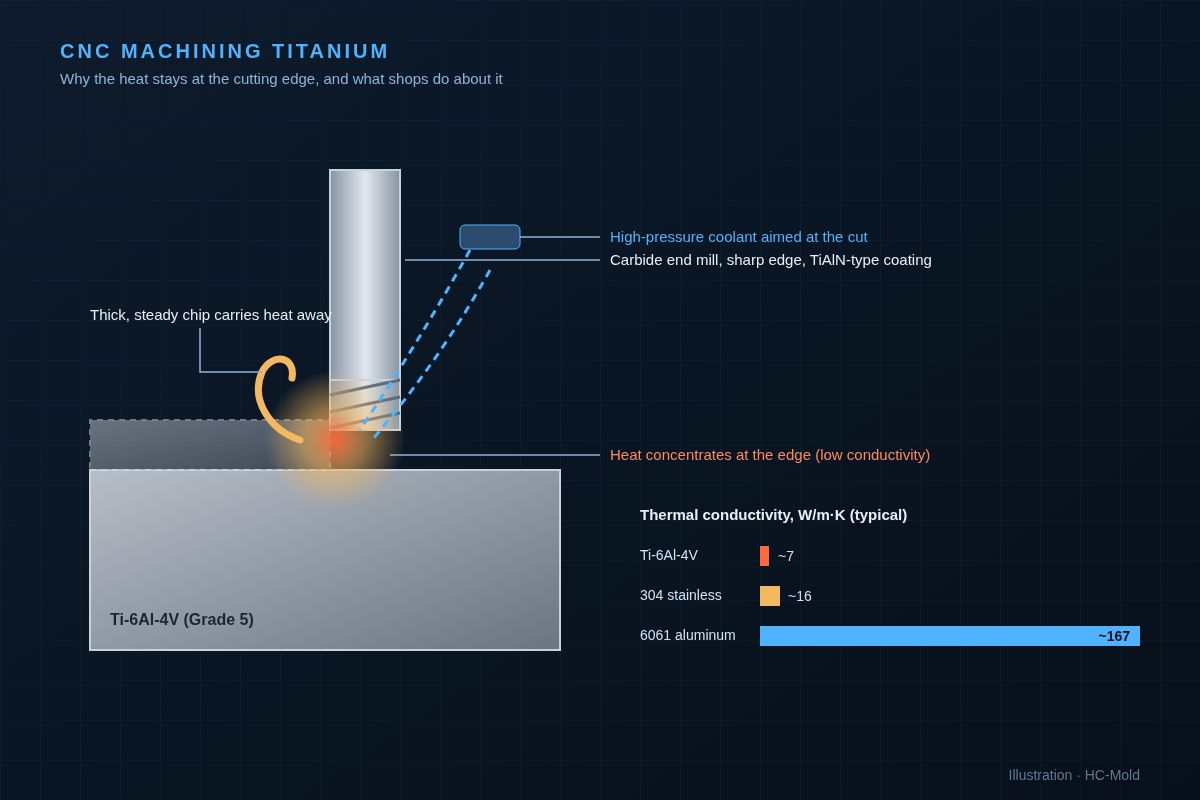
Why titanium is hard to machine
Titanium is hard to machine because four properties work against the cutter: low thermal conductivity, chemical reactivity with hot tools, low stiffness and work hardening. The table compares typical handbook values for the common grades with aluminum and stainless steel.
| Property (typical) | Ti-6Al-4V (Grade 5) | CP titanium (Grade 2) | 6061-T6 aluminum | 304 stainless |
|---|---|---|---|---|
| Density (g/cm³) | 4.43 | 4.51 | 2.70 | 8.0 |
| Tensile strength (MPa) | ~950 | ~345–450 | ~310 | ~515–620 |
| Elastic modulus (GPa) | ~114 | ~105 | ~69 | ~193 |
| Thermal conductivity (W/m·K) | ~7 | ~16–22 | ~167 | ~16 |
- Heat stays at the edge. Ti-6Al-4V conducts heat roughly 25 times worse than 6061. Heat that would leave through the part in aluminum goes into the tool instead, so cutting edges soften and wear fast.
- Chemical reactivity. At cutting temperatures titanium welds to the tool. The result is built-up edge, galling and chipped edges when the welded material breaks away.
- Low stiffness. With about half the elastic modulus of steel, thin walls and long features push away from the cutter and spring back. That causes chatter, taper and dimensions that move after unclamping.
- Work hardening. A tool that rubs instead of cutting hardens the surface it will meet on the next pass, which speeds wear further.
Fine titanium chips and dust can also ignite. Shops machine it wet, clear chips regularly and keep titanium swarf away from grinding sparks.
Titanium grades for CNC parts
Choose the lowest grade that meets the requirement. Commercially pure (CP) grades machine more easily than alloys and cost less to cut.
| Grade | Type | Machinability | Typical uses | Common bar/plate specs |
|---|---|---|---|---|
| Grade 1 | CP, softest | Best of the group, but gummy | Chemical equipment, formed parts | ASTM B348, B265 |
| Grade 2 | CP, the general-purpose grade | Good | Marine and chemical hardware, housings, heat exchangers | ASTM B348, B265 |
| Grade 4 | CP, strongest unalloyed | Fair | Fasteners, dental and medical hardware | ASTM B348, F67 |
| Grade 5 (Ti-6Al-4V) | Alpha-beta alloy | Poor to fair; the industry reference | Structural brackets, motorsport, aerospace fittings | ASTM B348, AMS 4928, AMS 4911 |
| Grade 23 (Ti-6Al-4V ELI) | Low-interstitial version of Grade 5 | Similar to Grade 5 | Surgical instruments, implants | ASTM F136 |
For a bracket that needs strength-to-weight, Grade 5 is the default. For a part that mainly needs corrosion resistance, Grade 2 is cheaper to buy and to machine, and it is easier to weld. Beta alloys such as Ti-5553 are harder still and are rarely worth it outside aerospace programs that require them.
How shops machine titanium: cutting practice
There is no single recipe, and the tool maker's data for the exact insert or end mill comes first. These are the practices most titanium shops follow:
| Factor | Typical practice | Why |
|---|---|---|
| Cutting speed | About 30–60 m/min with carbide for Grade 5; somewhat higher for CP grades | Tool life drops sharply as speed rises |
| Chip load | Constant, never so light that the tool rubs | Rubbing work-hardens the surface |
| Tool path | Low radial engagement, high axial depth (trochoidal or dynamic milling); climb milling | Spreads heat along the flute and gives the edge time to cool |
| Tools | Sharp carbide, PVD-coated (TiAlN-type), variable pitch; fresh tool for the finishing pass | Sharp edges cut instead of push; variable pitch damps chatter |
| Coolant | Flood or through-tool coolant at high pressure, aimed at the cut | Removes heat and flushes chips before they are recut |
| Workholding | Short stick-out, rigid fixtures, support under thin sections | Low stiffness amplifies any vibration |
| Holes and threads | Through-coolant drills with pecking; thread milling for critical threads | Taps seize in titanium; a broken tap can scrap the part |
The speed gap is the number buyers should remember: cutting speeds for Grade 5 are one-fifth or less of those for aluminum, which is why the same geometry takes several times longer to machine.
Design rules that keep titanium parts affordable
Most extra cost in a titanium part comes from geometry that was designed for aluminum. These rules of thumb help:
- Walls: keep walls at about 1.5–2 mm or thicker where you can. Thinner walls are possible but need light finishing passes and support.
- Internal corners: use the largest radius the design allows, ideally a little larger than the cutter radius, so the tool does not wrap into the corner and spike in load.
- Pocket depth: stay within about 4× the cutter diameter; deeper pockets need long, flexible tools.
- Holes: keep drilled depth within about 5× the diameter, and use standard drill sizes.
- Tolerances: apply tight tolerances only to functional features. A general tolerance such as ISO 2768-m on the rest saves real machine time. See CNC machining tolerances.
- Surface finish: milled Grade 5 is typically Ra 1.6–3.2 µm as machined. Call out Ra 0.8 µm or finer only on faces that need it; the surface roughness chart shows what each value costs in process terms.
- Material removal: if 80% of a billet ends up as chips, ask whether a near-net bar size, plate or a forged blank exists.
More general rules: CNC design for manufacturing.
Finishes for machined titanium
| Finish | What it does | Note |
|---|---|---|
| As machined | Fine tool marks, natural grey | Titanium forms its own oxide layer; many parts need nothing else |
| Bead blasting | Uniform matte texture, hides tool marks | Common for consumer and cosmetic parts |
| Color anodizing (AMS 2488 Type III) | Interference colors (gold, blue, purple) set by voltage, no dye | Very thin layer; dimensions barely change |
| Anti-galling anodize (AMS 2488 Type II) | Grey layer that reduces galling on threads and sliding parts | Specialist process; confirm the supplier offers it |
| Polishing | Lower Ra, bright surface | Slow on titanium; specify only where needed |
| Passivation / cleaning (ASTM F86 for implants) | Removes surface contamination | Medical parts follow their own cleaning validation |
| Laser marking | Part numbers, logos | No ink or contact |
Titanium anodizing is a different process from aluminum anodizing (MIL-A-8625). Ask whether your supplier anodizes titanium in-house or sends it out, because that affects lead time and color consistency between lots.
What drives the cost and lead time of titanium parts
- Material. Titanium bar and plate cost many times more per kilogram than aluminum, and certified aerospace or medical stock costs more again.
- Cycle time. Lower cutting speeds and lighter radial cuts mean longer machine time for the same geometry.
- Tooling. Cutters wear faster and are often replaced on a schedule rather than when they fail, so tool cost per part is higher.
- Features. Thin walls, deep pockets, small threads and tight tolerances multiply the effect of points 2 and 3.
- Paperwork. Mill certificates, first article reports and traceability add time to the quote and the shipment.
At HC-Mold, CNC prototypes take 3–5 days and production orders typically 5–10 days. For titanium, the bar or plate size and grade must be available, so confirm stock at the quote stage. We check material certificates on arrival, and every order ships with a 3D measurement report; first article reports and material certificates are available on request. For a fuller breakdown of CNC pricing factors, see how much does CNC machining cost?
When titanium is the wrong choice
Titanium earns its cost when you need strength-to-weight, corrosion resistance in seawater or chlorides, biocompatibility, or strength at elevated temperature, and usually two of these at once. If only one applies, there is often a cheaper material:
| If the real need is… | Consider first |
|---|---|
| Light weight with good strength | 7075-T6 aluminum, hard anodized for wear |
| Corrosion resistance at moderate cost | 316 stainless steel |
| Light, non-metallic, chemical-resistant | PEEK |
| Premium look on a consumer product | Bead-blasted, anodized aluminum |
One more honest limit: HC-Mold works to ISO 9001:2015 but does not hold AS9100 or ISO 13485. If your titanium part is flight hardware or a medical implant that requires those certifications, use a supplier who holds them. For prototypes, test fixtures, industrial and consumer parts, the certificate is not the constraint. For context, of the 78 RFQs that reached us through our website, 9 named aluminum, 5 named stainless steel and none named titanium, so if you are unsure, a DFM review that compares materials is worth asking for.
What to include in a titanium RFQ
- Grade and specification, for example "Ti-6Al-4V, ASTM B348 Grade 5, annealed".
- Whether you need mill certificates and full traceability.
- Quantity per lot and annual volume.
- Tolerances on critical features and a general tolerance for the rest.
- Surface finish (Ra) by face, and the final finish: blasted, anodized color, polished.
- Thread specification and whether threads need anti-galling treatment.
- Inspection requirements: first article report, CMM report, cleaning and packaging.
The CNC machining RFQ checklist covers the rest of the package.
FAQ
Is titanium hard to machine?
Harder than aluminum and most steels. Titanium conducts heat poorly, reacts with hot cutting tools and flexes under load, so it needs low cutting speeds, sharp carbide tools, high-pressure coolant and rigid fixturing. With those, it machines predictably.
What cutting speed should be used for titanium?
With carbide tools, Grade 5 Ti-6Al-4V is typically milled at about 30–60 m/min, and commercially pure grades somewhat faster. Start from the tool maker's data for the specific cutter and adjust for coolant pressure and rigidity.
Which titanium grade is easiest to machine?
Commercially pure grades, especially Grade 2, machine more easily than Ti-6Al-4V. Grade 1 is softer still but tends to be gummy. Choose Grade 5 only when you need its higher strength.
Is titanium more expensive to machine than stainless steel?
Usually yes. The raw material costs more, cutting speeds are lower and tools wear faster. A part that needs only corrosion resistance is often cheaper in 316 stainless steel.
Can machined titanium be anodized?
Yes. Titanium color anodizing (AMS 2488 Type III) produces gold, blue or purple interference colors without dye, and Type II anodizing reduces galling. It is a different process from aluminum anodizing, so confirm the supplier offers it.
Get a titanium part reviewed
Send your STEP file, drawing and grade. We return a free DFM review, flag features that will drive titanium cost, compare material options if you ask, and quote within 24 hours on a complete RFQ. See our CNC machining services.
Written by HC-Mold Engineering Team · Last updated: 2026-11-01
Talk to HC-Mold engineering
Free DFM · reply ≤12h · quote ≤24h on complete RFQ · ISO 9001:2015 · Dongguan, China