
An injection mold has two halves that meet at the parting line. The fixed half holds the top clamp plate, locating ring, sprue bushing and the A plate with the cavity insert. The moving half holds the B plate with the core insert, the support plate, spacer blocks and the ejector system. Guide pins align the halves, cooling channels control temperature, and slides or lifters form undercuts.
Knowing the parts of a mold helps you read a mold quote, follow a DFM review and understand why two quotes for the "same" tool can differ. This guide walks through each component of a standard two-plate mold, what it does, the steel we typically use for it at HC-Mold, and what it means for you as a buyer.
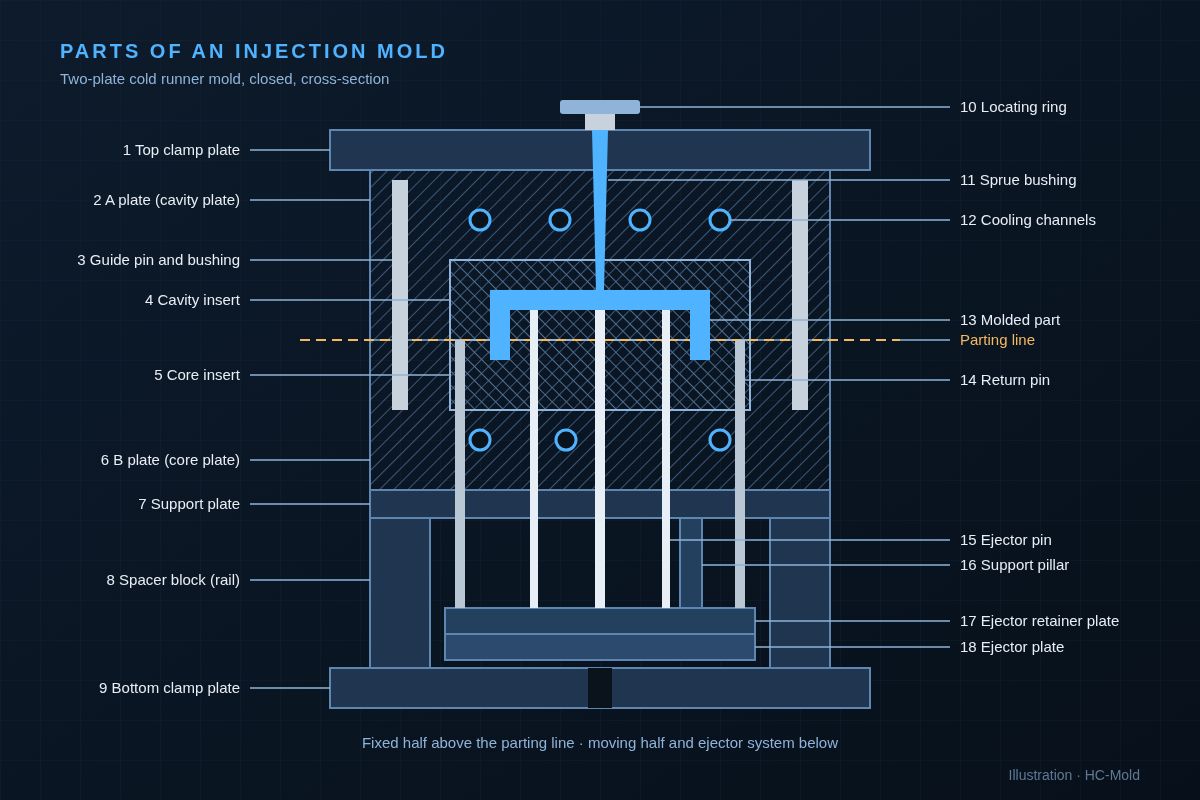
The two halves of a mold
Every injection mold opens along a parting line. The fixed half (also called the A side, cavity side or injection side) is bolted to the stationary platen of the molding machine, where the nozzle injects the plastic. The moving half (B side, core side or ejector side) is bolted to the moving platen. It opens after the part has cooled, and the ejector system pushes the part off the core.
Most of the parts below belong to the mold base, a set of standard plates and components. We build mold bases to the LKM, HASCO or DME standard the buyer specifies, which matters if your molder in another country needs to fit, maintain or replace parts.
Mold base plates
| # | Part | What it does | Typical steel |
|---|---|---|---|
| 1 | Top clamp plate | Clamps the fixed half to the stationary platen | S45C or similar medium-carbon steel |
| 2 | A plate (cavity plate) | Holds the cavity insert and cooling channels | S45C, or P20 when the cavity is cut directly in the plate |
| 6 | B plate (core plate) | Holds the core insert and cooling channels | S45C or P20 |
| 7 | Support plate | Backs up the B plate so injection pressure does not bend it | S45C |
| 8 | Spacer blocks (rails) | Create the space in which the ejector plates move | S45C |
| 9 | Bottom clamp plate | Clamps the moving half to the moving platen; has a hole for the machine's ejector rod | S45C |
What it means for you: plate size is set by the part size, the number of cavities and the space needed for slides and cooling. A bigger or thicker base costs more steel and machining, which is one reason multi-cavity molds cost more than single-cavity ones.
Cavity and core inserts
The cavity insert (4) forms the outside, usually cosmetic, surface of the part. The core insert (5) forms the inside. Together they are the most important and most expensive parts of the mold, because they are machined, EDM'd and polished to the part geometry and carry the surface finish you specify.
The insert steel is chosen for the volume, the resin and the finish:
| Steel | When we use it |
|---|---|
| P20, 718 / 718H, 738 / 738H (pre-hardened) | Most production molds; good machinability and polish for steady volumes |
| NAK80 | High-gloss and mirror-polished surfaces |
| SKD61 (H13), hardened | High volumes, glass-filled or abrasive resins; up to about 1,000,000 cycles |
| E420 stainless | Corrosive resins such as PVC, and clean-room or medical parts |
More detail: P20 vs H13 mold steel. Our molds carry a 300,000+ shot warranty, and hardened steel is selected when you need more.
Feed system: locating ring, sprue, runner and gate
- Locating ring (10) centers the mold on the machine platen so the nozzle lines up with the sprue.
- Sprue bushing (11) carries the melt from the nozzle through the fixed half. It is hardened because the nozzle seats against it every cycle.
- Runner distributes the melt from the sprue to each cavity. In a cold runner mold it solidifies and is ejected with the part; in a hot runner mold it stays molten inside a heated manifold, which removes runner waste and can shorten the cycle. We fit hot runner systems from YUDO, Synventive and other brands on request.
- Gate is the opening into the cavity. Its type and position affect weld lines, cosmetic marks and how easily the part can be degated.
More detail: hot runner vs cold runner.
Alignment: guide pins, bushings and interlocks
Guide pins and bushings (3) align the two halves every time the mold closes, so the cavity and core meet in the same place and the part wall thickness stays even. Precision molds and molds with deep cores also use parting line locks or interlocks for fine alignment. Worn guide components show up as flash or steps along the parting line, so they are a normal maintenance item.
Cooling channels
Cooling channels (12) are drilled through the plates and inserts to carry water or oil. Cooling usually takes the largest share of the molding cycle, so channel layout directly affects part price and warpage. We check cooling and fill in a mold-flow analysis before steel is cut.
Ejector system
- Ejector pins (15) push the part off the core. Their position, size and number are set to eject without marking or distorting the part; on cosmetic parts the pin marks are placed on hidden faces.
- Ejector retainer plate (17) and ejector plate (18) hold the pins and move them forward when the machine's ejector rod pushes.
- Return pins (14) push the ejector plates back when the mold closes, so the pins are not crushed.
- Support pillars (16) stand between the support plate and the bottom clamp plate to stop the B side from deflecting under injection pressure.
Other ejection methods include stripper plates, ejector sleeves for bosses and air ejection for deep, thin parts.
Side actions: slides and lifters
If a part has undercuts such as side holes, clips or snap-fits, the mold cannot simply open straight. Slides move sideways, driven by angle pins as the mold opens; lifters move at an angle with the ejector plate to release internal undercuts. Each slide or lifter adds design, machining and fitting time, so removing undercuts in the DFM review is one of the most effective ways to lower mold cost. See the plastic part DFM checklist.
Two-plate vs three-plate vs hot runner molds
| Mold type | How it differs | Typical use |
|---|---|---|
| Two-plate | One parting line; runner and part eject together | Most parts; simplest and lowest cost |
| Three-plate | Extra plate and second parting line so the runner separates from the part; allows pin-point gates in the middle of the part | Parts that need center gating without a hot runner |
| Hot runner | Heated manifold and nozzles replace the cold runner | High volumes, multi-cavity molds, less material waste |
What to check in a mold quote
- Mold base standard (LKM, HASCO, DME) and plate steel
- Cavity and core steel and hardness, and the number of cavities
- Cold or hot runner, and the hot runner brand
- Number of slides and lifters
- Surface finish (SPI polish or texture) on each face
- Mold life or shot warranty
- DFM review, mold-flow analysis, T0/T1 trials and sample reports
More detail: how much does an injection mold cost? and the injection mold RFQ checklist.
FAQ
What are the main parts of an injection mold?
The mold base plates (clamp plates, A and B plates, support plate and spacer blocks), the cavity and core inserts, the feed system (locating ring, sprue, runner and gate), guide pins and bushings, cooling channels, the ejector system, and slides or lifters for undercuts.
What is the difference between the core and the cavity?
The cavity forms the outside of the part and sits in the fixed half; the core forms the inside and sits in the moving half, where the ejector pins push the part off it.
Which mold part costs the most?
Usually the cavity and core inserts, because they are machined, EDM'd and polished to the part geometry. Slides, lifters and hot runner systems add significant cost when they are needed.
What is a mold base?
The standard set of plates, guide components and ejector plates that hold the cavity and core inserts. HC-Mold builds mold bases to the LKM, HASCO or DME standard you specify.
How long does an injection mold last?
It depends on the steel, the resin and maintenance. HC-Mold molds carry a 300,000+ shot warranty, and hardened steel is selected for up to about 1,000,000 cycles.
Get your mold reviewed
Send your STEP file and annual volume. We return a free DFM review with the mold configuration, steel and cavity recommendation, and a quote within 24 hours on a complete package. See our injection mold manufacturing service.
Written by HC-Mold Engineering Team · Last updated: 2026-11-01
Talk to HC-Mold engineering
Free DFM · reply ≤12h · quote ≤24h on complete RFQ · ISO 9001:2015 · Dongguan, China